Oct 27, 2015

The Goldfinch by Donna Tartt


Aged thirteen, Theo Decker, son of a devoted mother and an absent father, miraculously survives a catastrophe that otherwise tears his life apart. Alone and rudderless in New York, he is taken in by the family of a wealthy friend. Theo is tormented by longing for his mother and down the years he clings to the thing that most reminds him of her: a small, captivating painting that ultimately draws him into the criminal underworld.


This Pulitzer Prize winner is a big read, (700+ pages) and not everyone had managed to finish by the time we met this month, but for a few exceptions The Goldfinch was considered a worthy and, some would say, brilliant read.

Theo’s life never seemed to get on to a positive path, sending the novel into a downward spiral of self-destruction, obsession and in the end, uncertain conclusion. So why would we as readers enjoy this? Most of us put it down to good writing and a capacity to draw you into an exclusive, fictitious world. One which can be hard to shake yourself out of after a few hours of reading.
Tartt is a master at creating such a world, as proven in her first novel The Secret History.

Such literature is not for the faint of heart though. A few of us admitted to coming down with a small case of literary fatigue during the read, but generally the opinion was of … ‘it was worth it’, with the majority of us looking for the big picture message that must be contained within the many pages.
And although it was agreed the story was a little contrived, we put some effort into digging deeper and finding underlying themes. Art and beauty and the need for both scored high, also the struggle with guilt and loss, something Theo suffered throughout the book.

Character driven, this book chases many demons … sending readers swinging both ways with Theo and his cast, but along the journey something is built that stays with you once the last page is turned. And it is this fact alone that puts The Goldfinch into a category of worthwhile novels to read.  


Oct 20, 2015

Some Luck by Jane Smiley


1920. After his return from the battlefields in France, Walter Langdon and his wife Rosanna begin their life together on a remote farm in Iowa. As time passes, their little family will grow: from Frank, the handsome first-born, to Joe, Lillian, Henry, and Claire, the surprise baby who earns a special place in her father’s heart.

As Walter and Rosanna struggle to keep their family through good years and bad, the world around their little farm will turn, and life for their children will be unrecognizable from what came before.
Some will fall in love, some will have families of their own, some will go to war and some will not survive. All will mark history in their own way.

Smiley did not rate highly with our group this month. Her thoughtful writing style spent too much time on mundane items with little development in the storyline. Most struggled with the large cast of characters with no one really standing apart.

The first person narrative for main characters was praised by all, but this alone was not enough to raise the novel out of the doldrums. It may be true to life on an Iowa farm, but there were few who were keen to continue the trilogy of the Langdons and their 100 year history.

Those of us who did enjoy this novel found the slow and melodic rural life an enjoyable read with time to get acquainted with all the characters and their varied life paths. Sometimes a novel is just about people, their lives and their dreams … little excitements, but mostly the simple ‘walk of life’ that we all take.

The changing world takes awhile to impact on a rural community, but as the Langdons grow and scatter, the influences of childhood and familiar ties plays a powerful role in bringing everyone back and that is where this book pays tribute to what family really means.


Aug 28, 2015

Not the Same Sky by Evelyn Conlon

By 1848 famine has ravaged Ireland, and London remains undecided about what to do. A shortage of female labour in Australia offers a kind of solution and so, over the following two years more than 4000 Irish girls are shipped across vast oceans to an unimaginable world in the new colony. Only Sunday 28 October 1849, one of these ships, the Thomas Arbuthnot, sets sail from Plymouth with a cargo of girls under the care of Surgeon-superintendent Charles Strutt.
Not the Same Sky tells the story of Honora, Julie, Bridget and Anne. It observes them on the voyage, examining their relationship of trust with Charles Strutt, and follows them from Sydney as they become women of Australia, negotiating their new lives as best they can. A stark, poetic intensity gives these young women historical importance and human presence in an elegant and subtle novel suffused with humour.

This historical novel did not emotionally engage to some of our group’s complete satisfaction. It was thought the characters not ‘fleshed out’ enough and they held little substance for the reader. There was also the view that Charles Strutt was a little unrealistic, as was the voyage itself … things seemed just a little to pleasant and easy for the girls.
There were those who disagreed of course, stating that by the mid 1800s they had largely improved the route to Australia and the conditions in which free immigrants travelled. 
Our conversation led to the potato famine and the mass exodus from Ireland. Well read as our group is, everyone was aware of this tragic event, but some of us did not realise these young women were brought out to help fill the shortage of female labour in a new and developing Australia.
Ethical or not, these girls faced a frightening and unfamiliar future and most of our group felt the author did an admirable job of mixing fact with fiction, even if the characters lacked a certain amount of essence.
If Australian history is your thing, you will enjoy this novel from a knowledgeable, yet very readable author.


Jul 30, 2015

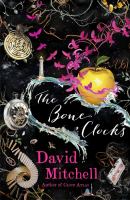
The Bone Clocks by David Mitchell

http://mylibrary.wollongong.nsw.gov.au/cgi-bin/spydus.exe/FULL/OPAC/ALLENQ/1818257/17657813,1
One drowsy summer’s day in 1984, teenage runaway Holly Sykes encounters a strange woman who offers a small kindness in exchange for ‘asylum’. Decades will pass before Holly understands exactly what sort of asylum the woman was seeking …
The Bone Clocks follows the twists and turns of Holly’s life from a scarred adolescence in Gravesend to old age on Ireland’s Atlantic coast as Europe’s oil supply dries up – a life not so far out of the ordinary, yet punctuated by flashes of precognition, visits from people who emerge from thin air and brief lapses in the laws of reality. For Holly Sykes – daughter, sister, mother, guardian – is also an unwitting player in a murderous feud played out in the shadows and margins of our world, and may prove to be its decisive weapon.
 
It is always clearly obvious when a special book passes through our book club. The comments and speculation on theme, plot and style start early, long before the scheduled discussion, and the general vibe during the meeting is turned up a notch or two.

Such was the case this month with David Mitchell’s latest novel The Bone Clocks. This book is so cram-packed with discussion material, it is hard to know where to start. The struggle between good and evil is clearly the over-riding theme, but Mitchell does this age-old conflict with such a new and exciting mix of realism and fantasy that he creates a literary vortex of deception, trickery and fifth dimensional combat. Once in there, literally impossible to pull out!
Not to everyone’s taste certainly, but the majority of our group loved this book. It breaks many grammatical rules and the narrative style does not come under the category of ‘easy reading’, but Mitchell’s craft of spinning an intertwining, complex tale of other worlds has to be appreciated. The topical subjects that he constantly plants within his plot make what might be a pure fantasy into something relevant.
Also admirable, is the fact that he can organise his stories to include references to his other novels, which are undetectable unless you’ve read them. And we agreed that the reoccurring presence of Holly’s character helped with stablising the story’s course.
It may sound like a difficult read, and some of us checked out the many online reviews to help with some clarifications of plot, (there are moments when a reader can easily get lost) and some found copious notes helped, but either way, it was a great effort by everyone to tackle this book and the majority of us feel it was an amazing read … one that scored high and will no doubt be a strong contender for our favourite book this year.


May 26, 2015

Love in a Cold Climate by Nancy Mitford

http://mylibrary.wollongong.nsw.gov.au/cgi-bin/spydus.exe/FULL/OPAC/ALLENQ/4945809/22528492,1Nancy Mitford's Love in a Cold Climate is a wickedly funny satire, brilliantly lampooning upper-class society.
When Polly, a beautiful aristocrat, declares her love for her married, lecherous uncle - who also happens to be her mother's former lover - she sparks off a scandal that has both disastrous and delicious consequences. Love in a Cold Climate is an unforgettable tale of the absurdities and obsessions of the elite.
 
Sometimes a book need be nothing more than just ‘rollicking good fun!’ (as the British upper classes might say) and a perfect description of this month’s classic read Love in a Cold Climate by Nancy Mitford. The over-drawn, preposterous characters had many of us laughing out loud, and once the small but conscious jump is made into Mitford’s writing style, there is nothing but fun to had within the lives of these satirical upper-crust characters.
We all had our favourites … Polly, Lady Montdore, Davey, Cedric, Aunt Emily … the cast is a wonderful mixture of crazy eccentrics that go about their business, never seeing or believing in the absurdity of their world or their part in it. Some of us were able to see people we know (or have known) within the characters, which always brings some enjoyment and a little more perspective to the reading.
We couldn’t find too much to be serious about with this novel. If there was a sober side it was the questionable fact that Polly needed only her beauty to happily exist. Although, we did end up having an interesting conversation on women’s education and marriage in the early 1900s, and the Mitford girls and their rather dubious relationship choices.
To finish, we all agreed with Nancy that Cedric’s parting comment summed up much of the book and was a classic worth noting …
So here we all are, my darling, having our lovely cake and eating it too.
One’s great aim in life.’


The Vintner's Letters by Peter McAra

http://mylibrary.wollongong.nsw.gov.au/cgi-bin/spydus.exe/ENQ/OPAC/ALLENQ?ENTRY=the+vintners+letters+peter&ENTRY_NAME=BS&ENTRY_TYPE=K&ISGLB=0&GQ=the+vintners+letters+peter

 
Son of an Irish father and a French mother, Maurice George O’Shea was a famous Australian winemaker. Educated in France, he was also a man of passion, a romantic. In the cultured and elegant Miss Marcia Fuller, an accomplished pianist, he found his enduring sweetheart.
Theirs would be a many-faceted and often stormy romance, confronted by religious differences and tested by life’s vicissitudes. But their greatest challenge lay in Maurice’s other consuming passion – making fine wines. He could not tear himself away from his beloved Hunter Valley vineyard. Marcia, every inch a city girl, was appalled by the primitive living conditions of the struggling vigneron.
The Vintner’s Letters is based on their true story as recounted by Simone Bryce, their daughter, and on the letters written by Maurice to Marcia during their courtship.

This year’s first guest for our An Audience with program, Peter McAra, delivered a wonderfully entertaining and informative talk last Wednesday night at Dapto Library, discussing his novel The Vintner’s Letters.
Reading a novel based on real people and their lives can be an engaging thing. It is so easy to imagine their life, empathize with the characters, understand their difficulties and feel good about their pleasures. This is exactly what McAra has given us in his novel.
Firstly he explained how he came to write Vintner’s Letters (an interesting story in itself) then the process of bringing these two people to life and why the story was released as a novel and not a biography.

Maurice O’Shea provided the foundation for this story with his letters to Marcie over the years of their courtship. Then, with the help of their daughter Simone Bryce, Peter built an authentic, yet compelling story of a man swept up in his dreams of creating superior wine and balancing this with his love for a young woman, all during a time when transport and communication was far from as easy as it is today. 
The story has all the vital ingredients of a great novel … romance, relationships, family dynamics and as Peter explained, that crucial ingredient for a good story, conflict!
Author discussions provide great insight into the artistic process of writing a book and Peter gave us many wonderful stories relating to his research and method of crafting creative non-fiction. For those of us who had already read The Vintner’s Letters, we came away feeling more informed and intimate with, not only the characters, but with the writing process in general …  something always welcomed by avid readers.
And for those who had not yet read the book? It has now moved to the top of their reading list!
From our Book Clubs and readers, a big thank you Peter, for giving your time and sharing your stories in such a personal and friendly manner. We hope you enjoyed it as much as we did!

Bel Canto by Ann Patchett

 
Somewhere in South America, at the home of the country’s vice president, a lavish birthday party is being held in honor of the powerful businessman Mr. Hosokawa. Roxane Coss, opera’s most revered soprano, has mesmerized the international guests with her singing.

It is a perfect evening – until a band of gun-wielding terrorists takes the entire party hostage. But what begins as a panicked, life-threatening scenario slowly evolves into something quite different, a moment of great beauty, as terrorists and hostages forge unexpected bonds and people from different continents become compatriots, intimate friends and loves.
 
Differing opinions about a book brings out a lively discussion, regardless of the subject matter. But this month’s read gave us fascinating material … music, culture and political struggle with a dash of humour, romance and operatic drama.
When I say differing opinions, our group’s scores for Bel Canto ranged from 2 to 10. The low scores found the story slow and filled with mundane details regarding the hostages’ confined stay. There were also comments regarding the fantastical nature of the story, with little connection to the Lima Crisis of 1996, which it was based on.
Our high scores found the story enthralling with characters that drew you in and moved you emotionally. They found empathy for all of them, hostages and insurgents alike. It was mentioned that music itself became a character and that the whole story read much like an opera (Intentional? We think so), setting a scene, building the characters and rising to a climax.
The story could easily be represented on a stage, so this idea is not unrealistic and it found sound credit with us.
We had a great discussion on opera and how it resonates with people’s emotions. Combined with the cultural variety of the hostages and their evolving relationships, most of us found the whole concept a thoroughly entertaining and worthy read.