Jan 29, 2016


It is 1922, and London is tense. Ex-servicemen are disillusioned, the out-of-work are demanding change. And in a genteel house in the south of the city, its inhabitants still recovering from the devastating losses of the First World War, life is about to be transformed.

Widowed Mrs Wray and her daughter, Frances  find themselves obliged to take in lodgers. The arrival of Lilian and Leonard Barber, a young couple of the ‘clerk class’ brings unsettling things with it – gramophone music, colour, fun. Open doors offer glimpses of the newcomers’ habits.
As Francis and Lilian are drawn into an unexpected friendship, loyalties begin to shift. Secrets are confessed and dangerous desires are admitted.

The most ordinary of lives, it seems, can explode into passion and drama.

If a bookclub’s year is set by the success of its first meeting, we are in for a beauty!
From ‘Loved it!’ to “Lacks direction’ and ‘Bloated narrative’ … these few comments sum up our group’s differing views of Sarah Waters’ latest novel The Paying Guests.
Our discussion focused mainly on Waters’ writing style. Some loved the way she is able to build tension and through narrative alone, create a perfect depiction of 1920s London … its people, class structure and political direction. Not an easy thing to do, but Waters does it not only well, but with real skill. The suppression experienced by Frances in England’s post war society is well represented and research for courtroom procedure spot on.
Some feel that Waters is a brave writer who has no fear in subscribing to the reader a duty of prediction and projection. No tidy little parcels tied up with bows and ribbons. Her characters and their situations read authentic, and as in real life, there are few precise outcomes. It is left to the reader to decide how such lives will continue.
This style of course, does not suit everyone. Some of the group found the novel too long and wordy. It lacked a sense of direction. The love triangle was found to be soppy and contrived, and altogether too predictable.
Once our diverging views were aired, we continued with a stimulating talk on domestic violence and the defining role of women in society throughout the centuries.
Hard to argue against the significance of a novel when it spawns such lively discussion … thank you ladies and welcome to another great year of reading!

Dec 21, 2015

Walking Free by Dr Munjed Al Muderis


In 1999, Munjed Al Muderis was a young surgical resident working in Baghdad when a squad of Military Police marched into the operating theatre and ordered the surgical team to mutilate the ears of army deserters. When the head of surgery refused, he was executed in front of his staff. Munjed's choices were stark -- comply and breach the medical oath 'do no harm', refuse and face certain death, or flee.
That day, Munjed's life changed forever. He escaped to Indonesia, where he boarded a filthy, overcrowded refugee boat, bound for Australia.
Like his fellow passengers, he hoped for a new life, free from dear and oppression, but for ten months he was incarcerated in what became known as the worst of the refugee camps, Curtin Detention Centre in Western Australia.
On 26 August 2000, Munjed was finally freed. Now, fourteen years late, he is one of the world's leading osseiointegration surgeons, transforming the lives of amputees with a pioneering technique that allows them to walk again. 

Finding the right voice for telling a biographical memoir, particularly in stressful and traumatic circumstances, can be a hit or miss affair. Too much emotion and the facts of a story are lost, too little and it becomes just another non-fiction book loaded with specifics.

Where does Walking Free land in this literary minefield? Well, our group, although scoring it high, generally found Al Muderis to be a little too removed from his situation and those around him. While using his professional skills to help, our readers felt he never really empathized with any of his fellow refugees and in his own mind, felt himself above their station.
It was pointed out by some that this could well be the product of his up-bringing and cultural class system.
Nobody argued this view and if honesty is important here, then the author did not fail to conform. For instance, we commented that he could of easily omitted the finer details of his escape from the hospital and Hussein’s henchmen, but instead he truthfully retold his act of hiding for hours in a women’s toilet before fleeing for his life. Not exactly hero worshipping stuff! But then his amazing work with orthopaedic medicine could not help but impress us all. Some members knew staff who worked with Al Muderis while at Wollongong Hospital and all reports had been good. So, maybe a written account cannot always transfer a person’s true nature.

Everyone found the cultural history and details of Iraq very interesting and felt they came away understanding a complex and unfamiliar society a little bit better. We were moved into having an interesting conversation on refugees … their circumstances, choices and constraints and also the  options we have in providing a humane and just society of our own.

We love it when a book leads us into such a discussion … if the writing wasn’t brilliant and the author’s personality not exactly to our taste, it matters little. The pay off is a friendly, supportive environment where we can all feel comfortable expressing our thoughts and opinions. And for that, Dr Al Muderis, we thank you. 

Nov 30, 2015

The End of Your Life Book Club


During her treatment for cancer, Mary Anne Schwalbe and her son Will spent many hours sitting in waiting rooms together. To pass the time, they would talk about the books they were reading. 
Once, by chance, they read the same book at the same time - and an informal book club of two was born. Through their wide-ranging reading, Will and Mary Anne - and we, their fellow readers - are reminded how books can be comforting, astonishing, and illuminating, changing the way that we feel about and interact with the world around us.

 When does a loving tribute turn into a sentimental dialogue of soppiness? The answer to that, dear reader, is in the hands that hold the book!

Our group was polarised somewhat this month. One member loved this book so much she purchased a copy for her shelf. She found the book discussions between mother and son extremely interesting and their journey endearing, and to a certain degree, reassuring. She loved the fact that Will took time out of his life to transport his ill mother to treatment, help her with a blog and generally support her through a life-ending illness. Doing all this without a hint of regret or selfish regard really is a mother’s greatest wish. We could all be so beholden!
Then there was the opposite side of the pole … these views found the saccharine discourse repetitive, dreary and simply too good and sweet to believe. Rather than feeling empathy for Mary Anne, they felt inadequate (the woman must have been a Saint!) and some felt the author gave into the urge to glorify his mother’s life. Therapy writing? Maybe … but most of our readers could not summon the empathy needed to consent to such a faultless accolade.
Grant it, these comments did not come without a certain amount of guilt … everyone felt they should have had more sympathy for someone fighting cancer so stoically. But then again, isn’t that the writer’s job …to arouse these emotions in us?
It was decided that the book itself was meant to pay homage to the author’s mother and heal a heart that had lost someone special. A nice thought, but something more honest, without the name dropping may have generated just a little more empathy within our group’s more stringent members.

Oct 27, 2015

The Goldfinch by Donna Tartt


Aged thirteen, Theo Decker, son of a devoted mother and an absent father, miraculously survives a catastrophe that otherwise tears his life apart. Alone and rudderless in New York, he is taken in by the family of a wealthy friend. Theo is tormented by longing for his mother and down the years he clings to the thing that most reminds him of her: a small, captivating painting that ultimately draws him into the criminal underworld.


This Pulitzer Prize winner is a big read, (700+ pages) and not everyone had managed to finish by the time we met this month, but for a few exceptions The Goldfinch was considered a worthy and, some would say, brilliant read.

Theo’s life never seemed to get on to a positive path, sending the novel into a downward spiral of self-destruction, obsession and in the end, uncertain conclusion. So why would we as readers enjoy this? Most of us put it down to good writing and a capacity to draw you into an exclusive, fictitious world. One which can be hard to shake yourself out of after a few hours of reading.
Tartt is a master at creating such a world, as proven in her first novel The Secret History.

Such literature is not for the faint of heart though. A few of us admitted to coming down with a small case of literary fatigue during the read, but generally the opinion was of … ‘it was worth it’, with the majority of us looking for the big picture message that must be contained within the many pages.
And although it was agreed the story was a little contrived, we put some effort into digging deeper and finding underlying themes. Art and beauty and the need for both scored high, also the struggle with guilt and loss, something Theo suffered throughout the book.

Character driven, this book chases many demons … sending readers swinging both ways with Theo and his cast, but along the journey something is built that stays with you once the last page is turned. And it is this fact alone that puts The Goldfinch into a category of worthwhile novels to read.  


Oct 20, 2015

Some Luck by Jane Smiley


1920. After his return from the battlefields in France, Walter Langdon and his wife Rosanna begin their life together on a remote farm in Iowa. As time passes, their little family will grow: from Frank, the handsome first-born, to Joe, Lillian, Henry, and Claire, the surprise baby who earns a special place in her father’s heart.

As Walter and Rosanna struggle to keep their family through good years and bad, the world around their little farm will turn, and life for their children will be unrecognizable from what came before.
Some will fall in love, some will have families of their own, some will go to war and some will not survive. All will mark history in their own way.

Smiley did not rate highly with our group this month. Her thoughtful writing style spent too much time on mundane items with little development in the storyline. Most struggled with the large cast of characters with no one really standing apart.

The first person narrative for main characters was praised by all, but this alone was not enough to raise the novel out of the doldrums. It may be true to life on an Iowa farm, but there were few who were keen to continue the trilogy of the Langdons and their 100 year history.

Those of us who did enjoy this novel found the slow and melodic rural life an enjoyable read with time to get acquainted with all the characters and their varied life paths. Sometimes a novel is just about people, their lives and their dreams … little excitements, but mostly the simple ‘walk of life’ that we all take.

The changing world takes awhile to impact on a rural community, but as the Langdons grow and scatter, the influences of childhood and familiar ties plays a powerful role in bringing everyone back and that is where this book pays tribute to what family really means.


Aug 28, 2015

Not the Same Sky by Evelyn Conlon

By 1848 famine has ravaged Ireland, and London remains undecided about what to do. A shortage of female labour in Australia offers a kind of solution and so, over the following two years more than 4000 Irish girls are shipped across vast oceans to an unimaginable world in the new colony. Only Sunday 28 October 1849, one of these ships, the Thomas Arbuthnot, sets sail from Plymouth with a cargo of girls under the care of Surgeon-superintendent Charles Strutt.
Not the Same Sky tells the story of Honora, Julie, Bridget and Anne. It observes them on the voyage, examining their relationship of trust with Charles Strutt, and follows them from Sydney as they become women of Australia, negotiating their new lives as best they can. A stark, poetic intensity gives these young women historical importance and human presence in an elegant and subtle novel suffused with humour.

This historical novel did not emotionally engage to some of our group’s complete satisfaction. It was thought the characters not ‘fleshed out’ enough and they held little substance for the reader. There was also the view that Charles Strutt was a little unrealistic, as was the voyage itself … things seemed just a little to pleasant and easy for the girls.
There were those who disagreed of course, stating that by the mid 1800s they had largely improved the route to Australia and the conditions in which free immigrants travelled. 
Our conversation led to the potato famine and the mass exodus from Ireland. Well read as our group is, everyone was aware of this tragic event, but some of us did not realise these young women were brought out to help fill the shortage of female labour in a new and developing Australia.
Ethical or not, these girls faced a frightening and unfamiliar future and most of our group felt the author did an admirable job of mixing fact with fiction, even if the characters lacked a certain amount of essence.
If Australian history is your thing, you will enjoy this novel from a knowledgeable, yet very readable author.


Jul 30, 2015

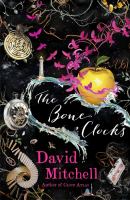
The Bone Clocks by David Mitchell

http://mylibrary.wollongong.nsw.gov.au/cgi-bin/spydus.exe/FULL/OPAC/ALLENQ/1818257/17657813,1
One drowsy summer’s day in 1984, teenage runaway Holly Sykes encounters a strange woman who offers a small kindness in exchange for ‘asylum’. Decades will pass before Holly understands exactly what sort of asylum the woman was seeking …
The Bone Clocks follows the twists and turns of Holly’s life from a scarred adolescence in Gravesend to old age on Ireland’s Atlantic coast as Europe’s oil supply dries up – a life not so far out of the ordinary, yet punctuated by flashes of precognition, visits from people who emerge from thin air and brief lapses in the laws of reality. For Holly Sykes – daughter, sister, mother, guardian – is also an unwitting player in a murderous feud played out in the shadows and margins of our world, and may prove to be its decisive weapon.
 
It is always clearly obvious when a special book passes through our book club. The comments and speculation on theme, plot and style start early, long before the scheduled discussion, and the general vibe during the meeting is turned up a notch or two.

Such was the case this month with David Mitchell’s latest novel The Bone Clocks. This book is so cram-packed with discussion material, it is hard to know where to start. The struggle between good and evil is clearly the over-riding theme, but Mitchell does this age-old conflict with such a new and exciting mix of realism and fantasy that he creates a literary vortex of deception, trickery and fifth dimensional combat. Once in there, literally impossible to pull out!
Not to everyone’s taste certainly, but the majority of our group loved this book. It breaks many grammatical rules and the narrative style does not come under the category of ‘easy reading’, but Mitchell’s craft of spinning an intertwining, complex tale of other worlds has to be appreciated. The topical subjects that he constantly plants within his plot make what might be a pure fantasy into something relevant.
Also admirable, is the fact that he can organise his stories to include references to his other novels, which are undetectable unless you’ve read them. And we agreed that the reoccurring presence of Holly’s character helped with stablising the story’s course.
It may sound like a difficult read, and some of us checked out the many online reviews to help with some clarifications of plot, (there are moments when a reader can easily get lost) and some found copious notes helped, but either way, it was a great effort by everyone to tackle this book and the majority of us feel it was an amazing read … one that scored high and will no doubt be a strong contender for our favourite book this year.